Interviews tell you what experts believe. They do not tell you what your own team is willing to do.
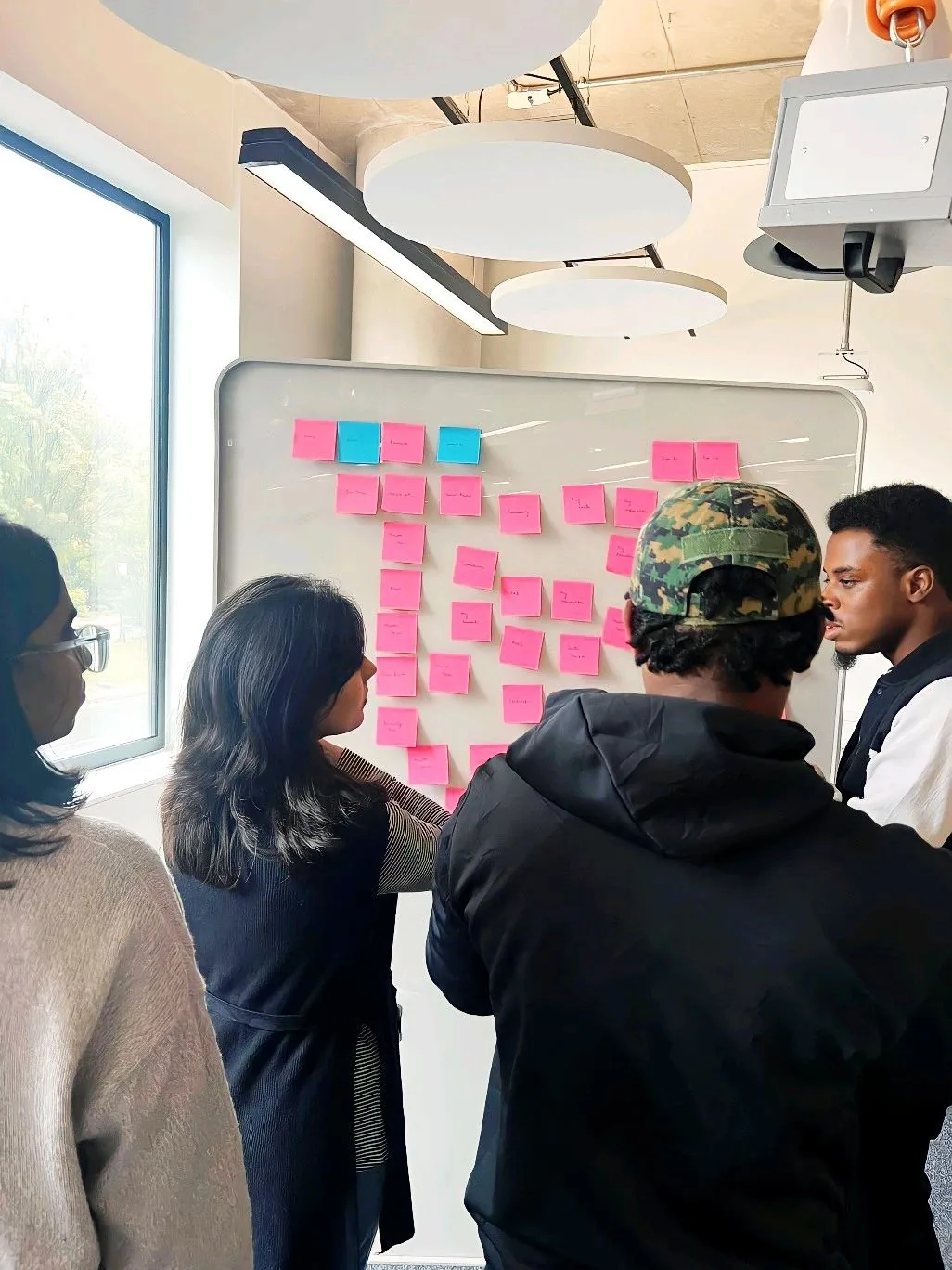
For my MSc thesis I ran a two-hour workshop with twelve people from a product organisation that did user research but had not adopted continuous discovery. The point was to pressure-test the themes from my expert interviews against a real team, and to find out what they would actually need to make it work.
The format worked well enough that it is worth handing over. Here it is, with the full question set.
The setup
- Two hours, run remotely on Microsoft Teams with a Miro board for the collaboration.
- Twelve participants, split into two rooms of six, each with a facilitator. The group covered product managers, product designers, UX designers, engineers and UX researchers.
- Eight themes and twenty-five questions, four themes per room, so both rooms ran in parallel and the whole set got covered in the time available.
- The board layout was deliberately plain: a theme at the top, its questions below, and empty space under each for sticky notes.
- Recorded, with consent, so nothing depended on the facilitators’ notes.
The rhythm that makes it work
This is the part worth copying exactly.
For each question, everyone gets four and a half to five minutes to add sticky notes at the same time. Not discussion. Silent, parallel ideation. Then everyone gets three votes to mark the answers they think matter most.
Two things come out of that. First, quiet people are not talked over, because ideas go up simultaneously rather than through whoever speaks first. Second, and this is the real prize, you end up with a ranked answer to every question rather than a general sense of the room.
Ranking is what makes the output usable afterwards. “The team thought priority should sit with one owner” is an impression. “Six of twelve votes went to a single owner deciding based on business priorities” is a finding you can act on and defend.
What to do with the output
Sort every answer by the number of votes it received, then analyse it the same way you would any other qualitative data. I used the same thematic analysis as for my interviews, which I describe in thematic analysis in practice.
The comparison is where the value is. Run this after expert interviews or desk research and you can see where your team agrees with the wider practice and where they do not. The gaps are usually the things that would have quietly killed your rollout.
The eight themes and 25 questions
Use these as they are, or cut them down to whichever four themes matter most to you.
1. Motivation. Why are we doing this at all?
- What can continuous research do for you?
- How do you measure the success of a research activity?
- How will you increase confidence in your research findings?
2. The process. What does it look like in practice?
- What should the continuous research process include?
- What does a request for research look like?
- How frequently should the research process be repeated?
3. The team. Who does the work?
- Who should be involved?
- What roles should they play?
- What kind of training would non-researchers need to run research activities?
4. Non-product team members. How wide does this go?
- Should non-product team members be involved, such as sales and the service desk?
- How should they be involved?
- What training would they need?
5. Analysis and insights. How do we make sense of it?
- How should the data be analysed to get quick insights?
- Who should conduct the data analysis?
- When should data analysis be conducted?
- How can insights be shared across the team?
6. Recruitment. Who do we talk to?
- How should participants be recruited for continuous research?
- How can the recruitment process be streamlined?
- How can participation and participation frequency be improved?
7. Documentation and backlog. Where does it all live?
- What should a backlog of findings look like, and what should it include?
- How should priorities be assigned to backlog items?
- How can backlog items lead to actionable workstreams?
- Where should it be created for maximum impact?
8. Research and AI. What is coming next?
- How can AI support the continuous research process?
- How can continuous research support the use of data and AI?
What surprised me
Two things, if you run this yourself, watch for them.
The team’s answers were often more operationally specific than the experts’. Practitioners talked about principles. The team talked about who owns the priority, which tool the executives can open, and what happens when the requester disappears after raising a request.
And their top-voted answers were rarely about research technique. They were about access to insight, ownership of decisions, and whether anyone would act on the findings. That matches what the expert interviews found about why continuous discovery is hard to sustain, which was reassuring, and slightly depressing.
Further reading
- Teresa Torres, Product Talk. producttalk.org
- My MSc research. The full study this workshop was part of. Read the case study
Next, read thematic analysis in practice or who should run continuous discovery.
Based on my MSc thesis on continuous product discovery. The research is written up in the case study.