Qualitative research has a gap that nobody enjoys talking about. You finish the interviews, you have hours of recordings and pages of notes, and somewhere between that pile and a clear set of findings there is a step everyone describes vaguely as “synthesis”.
For my MSc thesis I ran eight expert interviews and analysed them using Braun and Clarke’s six-phase thematic analysis. This is what each phase actually involved, including the tools and the parts that were harder than expected.
Before the analysis: getting good data
Analysis cannot rescue weak interviews, so the setup matters.
I recruited in two stages. First I built a list of organisations on LinkedIn doing product discovery, deliberately spanning B2B, B2C and consultancies so the sample would not skew to one type. Then I ran a short screening survey through Microsoft Forms, plus polls on LinkedIn, Reddit and Slack, to find people genuinely involved in continuous discovery rather than just interested in it. The most relevant respondents were invited.
That produced eight participants, four men and four women, in roles including Principal UX Researcher, UX Research Ops, Product Owner and Senior Staff Research Consultant.
The interviews were semi-structured, 45 to 60 minutes each, held on Microsoft Teams with a pre-defined guide of fourteen open-ended questions. Semi-structured is the right choice when you need to compare answers across participants but also want people to raise things you did not think to ask.
One thing worth knowing before you start: qualitative research is iterative. Early analysis changed my later interviews. Questions that were not producing anything useful got dropped, and new ones appeared as topics surfaced.
Ethics were handled before any session: information sheets explaining the study, signed consent forms, the right to withdraw at any point without consequence, and all data stored under GDPR in anonymised form.
Phase 1: Familiarisation
Recordings went into Dovetail for transcription, and I reviewed each transcript against the recording for accuracy.
This phase is mostly reading, and it feels unproductive. It is not. You are building the mental map that lets you notice, in interview seven, that someone has just contradicted what interview two said.
Phase 2: Generating initial codes
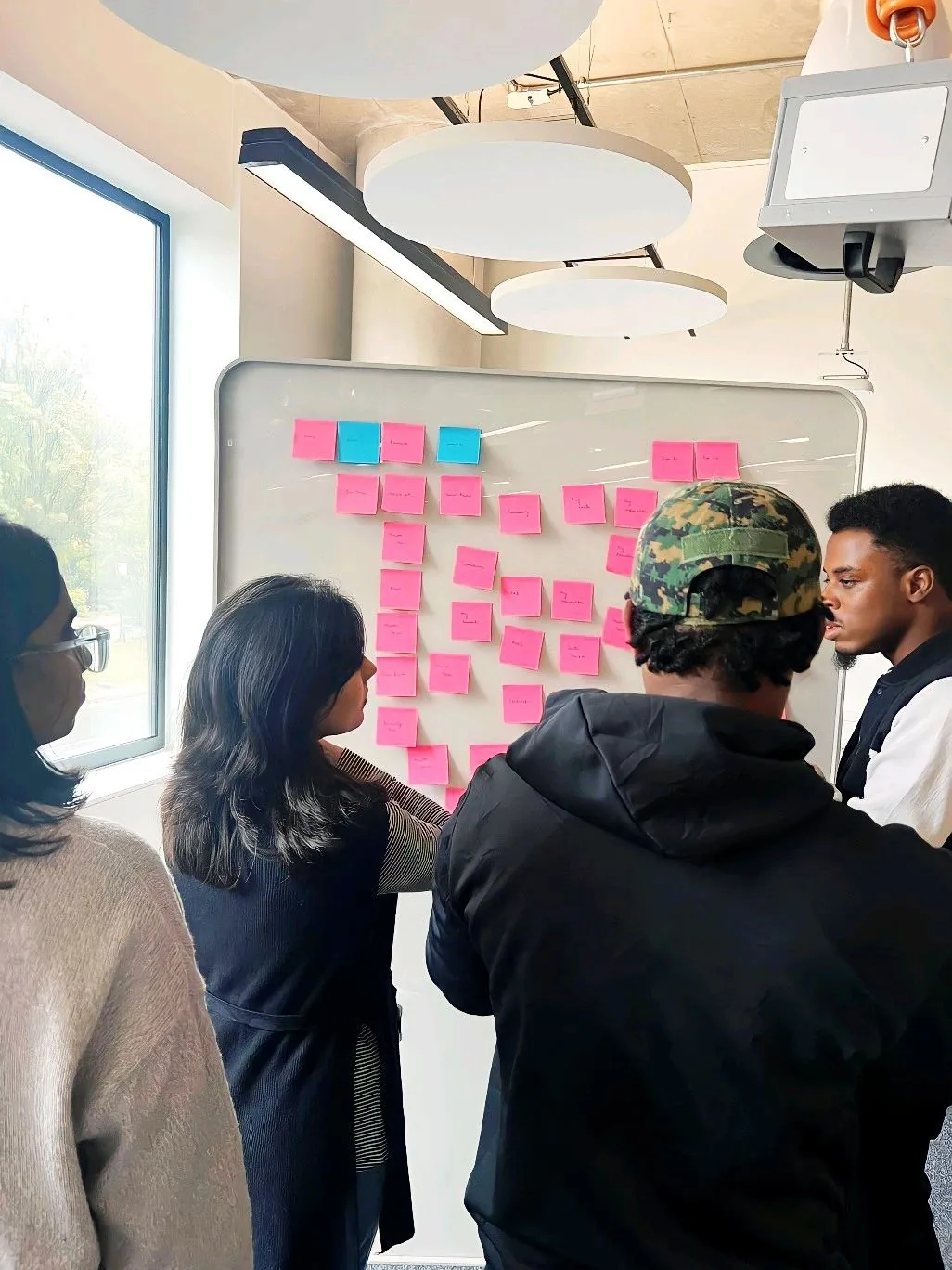
I tagged the transcripts in Dovetail first, then moved into Miro for the deeper work, because being able to physically move codes around a board makes patterns visible in a way that a list does not.
This produced 23 initial topics.
Two kinds of coding matter here:
- Semantic codes capture what participants said directly. Someone says recruitment is hard, you code recruitment difficulty.
- Latent codes capture what is implied underneath. Nobody in my interviews said “we abandoned this because leadership never really believed in it”, but several described situations where that was clearly what happened.
The latent codes carried a lot of the useful material, particularly around why teams quietly stop doing continuous discovery. Watch for repeated concepts, words carrying emphasis or stress, and points where participants disagree with each other.
Phase 3: Searching for themes
Now you group codes into candidate themes. In Miro this is literally clustering sticky notes and trying different arrangements.
The main trap is grouping by topic rather than by meaning. “Recruitment” is a topic. “Access to users is the bottleneck that quietly kills the process” is a theme. Themes should say something.
Phase 4: Reviewing themes
This is where candidate themes get tested. Some collapse into others, some split, some turn out to be one loud participant rather than a pattern.
I checked each theme two ways: did the coded extracts underneath it actually belong together, and did the set of themes represent the dataset as a whole. I also compared responses across participants to see which patterns held across all eight and which were specific to one organisation. That distinction matters when you write up, because it is the difference between a finding and an anecdote.
Phase 5: Defining and naming
Each theme gets a clear definition and a name that says what it means.
The 23 initial topics resolved into six themes: traditional user research, the continuous discovery process, analysing and documenting insights, the impact of continuous discovery, variation and challenges, and the future of continuous discovery.
I built a thematic map for each one, showing sub-themes underneath, which ended up being about eighteen maps in total. That sounds excessive but it was the thing that made the write-up straightforward, because the structure of the findings chapter was already decided.
Phase 6: Writing the report
Writing is part of the analysis, not a step after it. Gaps you had not noticed become obvious when you try to explain a theme in full sentences.
I connected each finding back to specific coded extracts and kept participant quotes throughout, which is what lets a reader judge the interpretation for themselves rather than taking your word for it.
What I would tell someone starting
- Budget more time for analysis than collection. People always underestimate this side.
- Do not analyse alone if you can avoid it. Different readings of the same quote are useful, and discussing them exposes your own assumptions.
- Keep the quotes attached to everything. Findings without evidence get argued with. Findings with a direct quote underneath rarely do.
- Expect to move backwards. I went back to earlier phases repeatedly. That is the method working, not you doing it wrong.
Further reading
- Braun and Clarke (2006), Using thematic analysis in psychology. The original paper, and still the clearest explanation. tandfonline.com
- My MSc research. The full study this method was used for. Read the case study
Next, read how to turn research insights into action or how to avoid confirmation bias.
Based on the methodology of my MSc thesis on continuous product discovery. The full research is written up in the case study.